
Businesses increasingly use artificial intelligence to communicate with customers, answer questions, provide recommendations, and deliver faster support. However, as these systems handle sensitive information, protecting customer data has become a critical responsibility. Effective AI chatbot security helps businesses prevent unauthorized access, reduce privacy risks, and maintain customer trust while delivering convenient digital experiences.
Modern chatbots may process personal details, account information, purchase histories, and confidential business communications. Without appropriate security controls, this information can become vulnerable to data breaches, prompt injection attacks, unauthorized disclosure, and other cybersecurity threats. Businesses using Generative AI chatbots, Chatbot integration, and Live chat automation must therefore prioritize security throughout the development, deployment, and maintenance process.
A comprehensive security strategy combines strong access controls, data encryption, privacy-focused design, continuous monitoring, and responsible AI practices. By implementing these measures, organizations can protect customer information while maintaining the efficiency and usefulness of AI-powered customer service.
Understanding AI Chatbot Security
AI chatbot security refers to the technologies, policies, and practices used to protect chatbot systems, customer information, and connected business applications from security threats. It includes safeguarding conversations, controlling access to sensitive data, preventing malicious inputs, and ensuring that chatbots operate within approved boundaries.
Unlike traditional software, AI-powered chatbots may generate responses dynamically and interpret complex natural-language instructions. These capabilities introduce additional risks, particularly when chatbots access external databases, use third-party services, or perform actions on behalf of customers.
Why Chatbot Security Matters for Businesses
Customer trust depends on how responsibly a business handles personal information. If a chatbot exposes private conversations or provides unauthorized access to account details, the consequences can include financial losses, reputational damage, regulatory penalties, and customer dissatisfaction.
Strong security practices help businesses reduce these risks while maintaining reliable customer service. They also support compliance with applicable privacy regulations and internal security policies. Organizations should treat chatbot security as an ongoing business requirement rather than a feature that can be added after deployment.
Protect Customer Information Through Data Encryption
Transport Layer Security (TLS) can protect communications between customers, chatbot applications, and backend services. Encryption at rest helps safeguard stored information if storage systems or backups are accessed without authorization. However, encryption must be combined with appropriate key management, access restrictions, and monitoring to provide meaningful protection.
Secure Sensitive Customer Data
Businesses should identify which information their chatbots collect and determine whether each data element is necessary. Personal identification details, payment information, authentication credentials, and confidential account records require particularly careful handling.
Chatbots should avoid collecting unnecessary sensitive information during ordinary conversations. When sensitive information must be processed, businesses should use secure workflows designed for that purpose. Payment details, for example, should generally be handled through appropriately secured payment systems rather than ordinary chatbot messages.
Secure Generative AI chatbots Against Emerging Threats
Generative AI chatbots can produce natural responses, summarize information, and help customers complete complex tasks. However, their ability to interpret instructions and generate content creates security challenges that differ from those associated with traditional rule-based chatbots.
One important threat is prompt injection, in which malicious instructions attempt to manipulate the model into ignoring its intended restrictions or revealing information it should not disclose. Other risks include sensitive information appearing in generated responses, malicious content entering retrieved documents, and unauthorized actions being triggered through connected tools.
Prevent Prompt Injection and Unauthorized Disclosure
Businesses should treat customer messages, uploaded documents, retrieved web content, and external data as potentially untrusted inputs. Instructions found inside those sources should not automatically override the chatbot’s system-level rules or security requirements.
Developers should separate trusted instructions from user-provided content and limit the information available to the model. Sensitive actions should require independent authorization checks outside the model itself. Output filtering and security testing can provide additional protection, although no single defense completely eliminates prompt injection risks.
Organizations should also test how their chatbots respond to requests for confidential information, attempts to bypass restrictions, and instructions embedded in documents. Regular testing helps identify weaknesses before attackers exploit them.
Strengthen Authentication and Access Controls
Authentication and authorization help ensure that customers can access only the information and services they are permitted to use. A chatbot should never assume that a person is authorized to view an account simply because they know an email address, order number, or other easily obtained detail.
Businesses should verify customer identities before allowing access to private records or account-specific actions. Authentication requirements should reflect the sensitivity of the requested operation, with stronger verification for higher-risk activities.
Apply the Principle of Least Privilege
The principle of least privilege means that every user, application, and system component receives only the permissions necessary to perform its assigned responsibilities. A chatbot that answers general product questions should not automatically receive access to customer payment records or administrative systems.
Developers should use narrowly scoped application permissions, separate service accounts, and secure credential storage. Administrative access should be restricted to authorized personnel, while sensitive operations should require explicit permission checks.
These controls reduce the potential damage caused by compromised credentials, malicious instructions, or software vulnerabilities.
Implement Secure Chatbot integration
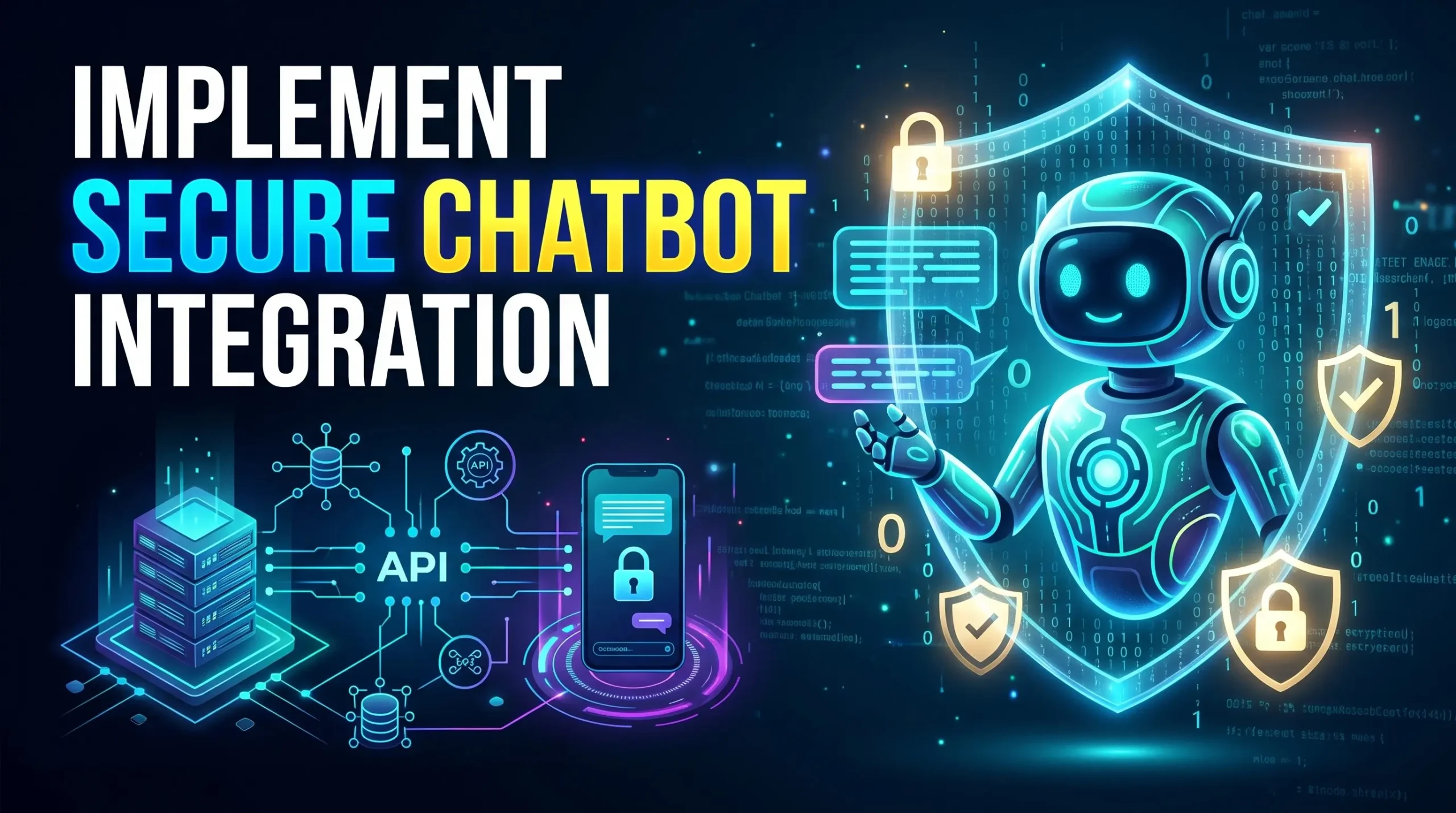
Every integration introduces additional permissions, data flows, and dependencies that require protection. Businesses should evaluate each connected service before enabling access and confirm that information moves only between authorized systems.
Protect APIs and Third-Party Services
Application programming interfaces (APIs) allow chatbots to exchange information with other applications. Developers should protect these interfaces with appropriate authentication, authorization, input validation, and rate limiting.
API keys and access tokens should never be exposed in chatbot responses, browser-side code, or public repositories. Credentials should be stored securely, rotated when appropriate, and revoked immediately when they are no longer needed.
Businesses should also evaluate third-party chatbot providers, plugins, and integration services. Security assessments should consider data handling practices, retention policies, access permissions, vulnerability management, and incident notification procedures.
Before connecting a chatbot to a business application, organizations should test whether unauthorized requests can retrieve restricted records or trigger unintended actions.
Improve Privacy Through Secure Live chat automation
Live chat automation helps businesses respond to customer questions, route support requests, and manage routine service tasks without requiring an employee to handle every interaction. However, automated conversations may collect personal information and generate records that require appropriate privacy protections.
Businesses should explain what information they collect, why it is needed, and how it will be used. Privacy notices should be understandable and accessible before customers submit sensitive information. Data collection should remain limited to legitimate business purposes.
Establish Data Retention and Deletion Policies
Chatbot conversations may contain addresses, contact information, account details, or other personal information. Keeping every conversation indefinitely increases the amount of data that could be exposed during a security incident.
Organizations should establish retention periods based on operational needs, applicable laws, and contractual requirements. Information that is no longer necessary should be securely deleted or appropriately anonymized.
Businesses must also consider copies of conversations stored in analytics platforms, support systems, backups, and third-party services. Deletion policies should account for these locations wherever applicable.
When customer conversations are used to improve AI models, businesses should assess whether that processing is necessary, lawful, transparent, and consistent with their stated privacy commitments.
Monitor Chatbot Activity and Detect Security Threats
Continuous monitoring helps businesses identify suspicious behavior, investigate incidents, and maintain visibility into how their chatbots interact with customers and connected systems. Monitoring can reveal unusual request volumes, repeated authentication failures, unexpected data access, and attempts to exploit chatbot vulnerabilities.
Organizations should establish clear security events to monitor and define how alerts will be investigated. Automated detection tools can help security teams identify patterns that would be difficult to recognize through manual reviews alone.
Maintain Secure Audit Logs
Audit logs help organizations understand what happened during a security incident. Useful records may include authentication events, administrative changes, API access, permission failures, and sensitive actions performed through chatbot integrations.
However, logging must not become another source of privacy risk. Logs should exclude passwords, authentication tokens, and unnecessary sensitive conversation content. Access to logs should be restricted, and stored records should be protected against unauthorized modification.
Businesses should regularly review monitoring rules and test whether alerts work as expected. A documented incident response plan should explain how to investigate suspicious activity, contain affected systems, notify appropriate stakeholders, and restore normal operations.
Train Employees and Establish AI Security Policies
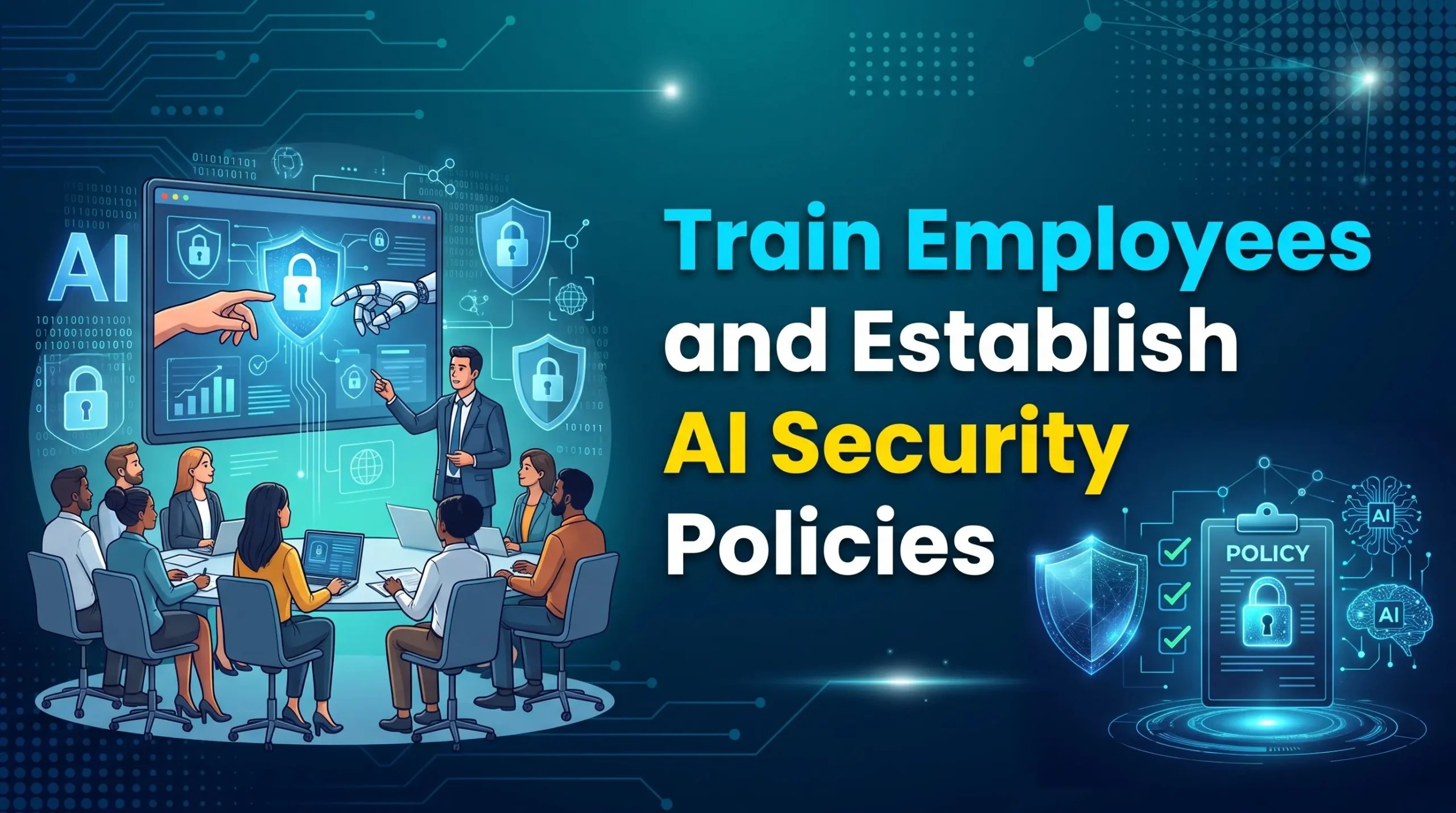
Organizations should provide training on privacy requirements, secure data handling, phishing, credential protection, and appropriate use of AI tools. Staff should understand which information may be entered into approved systems and which information must remain restricted.
Create a Responsible AI Governance Framework
A responsible AI governance framework defines how chatbots are approved, deployed, monitored, and updated. It should establish ownership, risk assessment procedures, security testing requirements, and accountability for decisions involving customer information.
Businesses should document the chatbot’s intended purpose, approved data sources, permitted actions, and access limitations. Higher-risk applications may require additional human oversight and independent security reviews.
Organizations should also maintain an inventory of deployed chatbots and connected services. This makes it easier to identify outdated systems, review permissions, and ensure that security responsibilities remain clear as business requirements change.
Test and Update AI Chatbot Security Regularly
Security threats evolve as chatbot technologies, integrations, and attack techniques change. Businesses should therefore evaluate their systems before launch and repeat security assessments whenever important models, APIs, permissions, or workflows are modified.
Testing should examine authentication weaknesses, access control failures, sensitive information disclosure, prompt injection, malicious file uploads, and unsafe tool usage. Where appropriate, organizations should use independent security specialists to assess higher-risk systems.
Follow a Continuous Improvement Process
Security testing should lead to measurable improvements. Businesses should prioritize vulnerabilities according to their potential impact, assign responsibility for remediation, and verify that fixes work as intended.
Organizations should also review incidents, near misses, customer complaints, and emerging threat intelligence. These findings can inform updated security controls and employee training.
A continuous improvement approach helps businesses adapt to changing risks without unnecessarily limiting chatbot functionality. The goal is to provide useful AI-powered services while maintaining strong protections for customer information.
Conclusion
Effective AI chatbot security requires a comprehensive approach that protects customer information throughout the entire chatbot lifecycle. Encryption, authentication, least-privilege access, secure integrations, privacy-focused data management, and continuous monitoring all contribute to reducing security risks.
Businesses using Generative AI chatbots, Chatbot integration, and Live chat automation should also address prompt injection, third-party dependencies, sensitive information disclosure, and unauthorized actions. Regular security testing, employee training, and responsible AI governance help maintain these protections as technology evolves.
Ultimately, secure chatbots do more than answer questions efficiently. They help businesses demonstrate responsibility, protect customer relationships, and build confidence in AI-powered services. By making security a core design requirement, organizations can pursue automation and innovation without overlooking customer privacy.
Frequently Asked Questions
1. What is AI chatbot security?
AI chatbot security involves the practices and technologies used to protect chatbot systems, customer information, and connected applications from unauthorized access, data exposure, malicious inputs, and other cybersecurity threats.
2. Why is AI chatbot security important?
It helps prevent data breaches, protect customer privacy, reduce business risks, and maintain trust. Strong security also supports compliance with applicable data protection requirements and organizational policies.
3. What are the biggest security risks for AI chatbots?
Common risks include prompt injection, sensitive information disclosure, weak authentication, insecure APIs, excessive permissions, malicious file uploads, and vulnerabilities in third-party services.
4. How can businesses protect customer information in AI chatbots?
Businesses should encrypt data, minimize information collection, enforce access controls, secure integrations, restrict sensitive actions, monitor suspicious activity, and establish appropriate data retention policies.
5. Are Generative AI chatbots secure?
Generative AI chatbots can be deployed securely, but their safety depends on system design, access restrictions, data handling, monitoring, and ongoing testing. No chatbot is automatically secure simply because it uses a reputable AI model.
6. How does prompt injection affect chatbot security?
Prompt injection attempts to manipulate a chatbot through malicious instructions embedded in messages or external content. It may cause inappropriate responses or expose information when other security controls are inadequate.
7. How can businesses secure Chatbot integration?
Businesses should authenticate API requests, validate inputs, enforce least-privilege permissions, protect credentials, monitor connected services, and regularly test integrations for unauthorized access.
8. Does Live chat automation create privacy risks?
Yes. Live chat automation can process personal information and store conversation histories. Businesses should minimize data collection, communicate privacy practices clearly, restrict access, and delete information when retention is no longer necessary.
9. Should chatbot conversations be stored?
Conversation storage should depend on legitimate business needs, privacy requirements, and applicable laws. Businesses should define retention periods, protect stored records, restrict access, and securely delete information when appropriate.
10. How often should AI chatbot security be tested?
Security should be assessed before deployment, after significant system changes, and periodically throughout operation. Continuous monitoring and risk-based testing help organizations identify vulnerabilities as threats and chatbot capabilities evolve.

AI Chatbot Security Strategies to Protect Customer Information
How Omnichannel Chatbot Solutions Drive Customer Engagement
AI Chatbot Personalization for Smarter Customer Interactions
Chatbot Analytics and Reporting Strategies for Better Business Performance