

Businesses generate enormous amounts of information through customer conversations, emails, reviews, surveys, social media posts, support tickets, documents, and online interactions. Much of this information is stored as unstructured text, making it difficult to analyze using traditional data-processing methods. Natural language processing helps businesses transform human language into useful data that can be analyzed, categorized, and interpreted.
Natural language processing combines artificial intelligence, computational linguistics, and machine learning techniques to help computers understand and process human language. It can identify keywords, classify text, recognize sentiment, extract important information, and detect patterns across large volumes of written or spoken data.
What Is Natural Language Processing?
Natural language processing, commonly known as NLP, is a field of artificial intelligence that focuses on enabling computers to understand, interpret, and generate human language.
Traditional data analysis often works with structured information such as numbers, dates, categories, and predefined fields. NLP expands analytical capabilities by allowing organizations to work with unstructured text and language-based information.
How Natural Language Processing Works
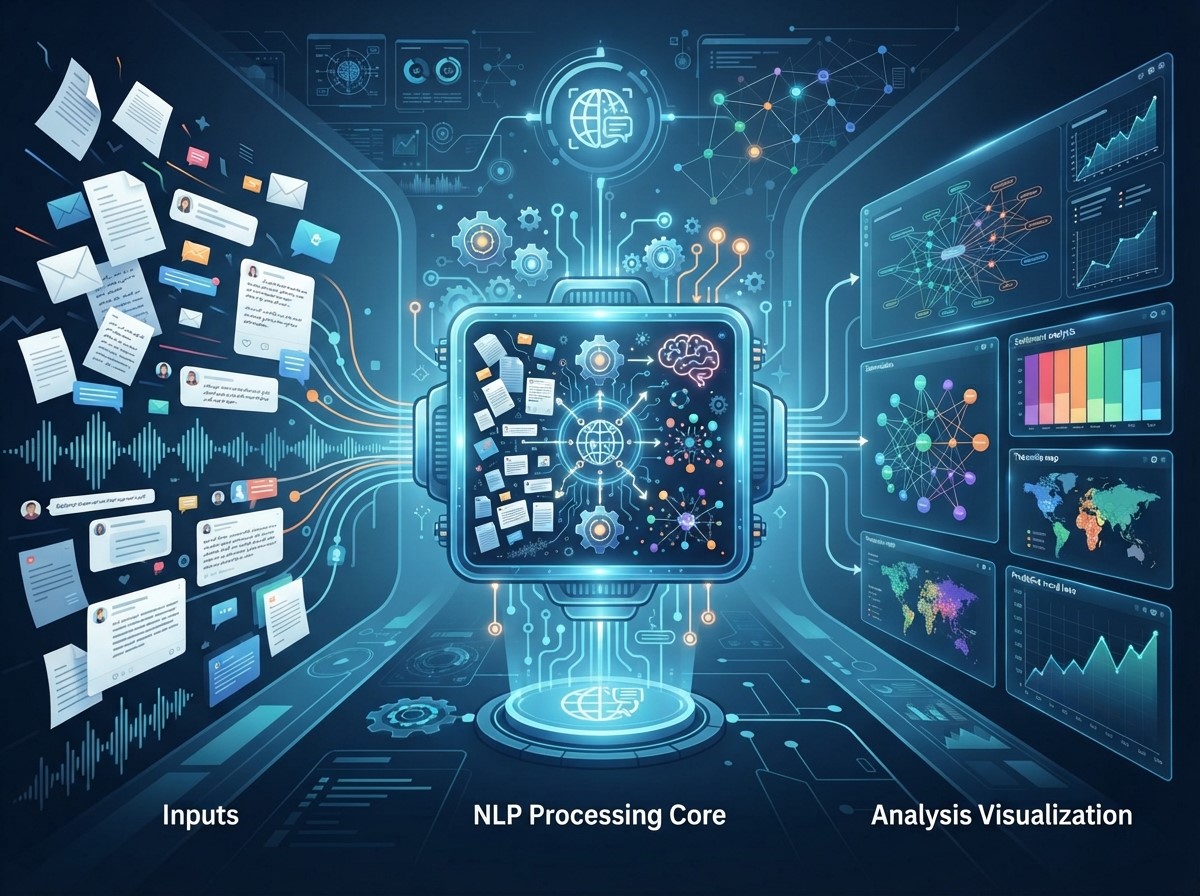
NLP systems process language through several stages. Depending on the application, these may include text classification, entity recognition, sentiment analysis, language translation, keyword extraction, summarization, and intent detection.
Machine learning models can analyze large collections of language data and identify patterns. These patterns can then be used to categorize information, extract insights, or support automated workflows.
Structured and Unstructured Data
Structured data is organized into predefined fields, making it relatively easy for traditional analytics tools to process. Unstructured data includes emails, reviews, documents, comments, conversations, and other forms of free-form text.
NLP helps convert parts of this unstructured information into structured categories or measurable insights, making it more useful for business analysis.
How NLP Improves Data Analysis
Faster Text Analysis
Manually reviewing large amounts of text can take significant time. NLP systems can process thousands of documents, reviews, or conversations much faster than manual analysis.
For example, an organization can analyze customer feedback from multiple channels and identify frequently mentioned issues. This allows teams to discover patterns without individually reviewing every message.
Better Information Extraction
Important information may be hidden inside long documents or conversations. NLP can extract names, organizations, products, locations, dates, topics, and other relevant entities.
This information can then be organized into structured datasets for further analysis. Automated extraction is particularly useful when businesses process large volumes of documents regularly.
Sentiment Analysis and Customer Insights
Sentiment analysis is one of the most widely used NLP applications for data analysis. It helps identify whether text expresses positive, negative, or neutral sentiment.
Businesses can apply sentiment analysis to reviews, surveys, social media conversations, customer support messages, and other sources to understand how audiences respond to products, services, or experiences.
Understanding Customer Opinions
Customer opinions are often expressed in natural language rather than numerical ratings. A customer may describe a product as useful but complain about delivery delays.
NLP can analyze these statements and identify the overall sentiment while also extracting specific topics. This provides businesses with more detailed insights than a simple numerical score.
Identifying Emerging Issues
NLP can help organizations identify repeated complaints or emerging topics. If many customers begin mentioning the same issue, automated analysis can highlight the trend.
Early identification can help teams investigate potential problems before they become widespread. Human analysts can then review the relevant conversations and determine the appropriate response.
NLP in Customer Service Data Analysis
Customer service departments generate large volumes of conversational data through emails, support tickets, live chats, and messaging platforms. NLP can analyze these interactions to identify common questions, recurring problems, and customer sentiment.
This information can help organizations improve both customer service processes and product experiences.
Analyzing Support Conversations
NLP can categorize support conversations according to topic, intent, urgency, or customer sentiment. This allows businesses to understand which issues generate the most support requests.
For example, an organization may discover that customers frequently ask about account access, billing, delivery, or product setup. These patterns can guide improvements to support resources.
Connecting NLP With Chatbot Technology
Chatbot technology increasingly relies on NLP to understand customer messages and determine appropriate responses. Instead of requiring customers to select from rigid menu options, NLP-powered systems can interpret natural language questions.
The resulting conversation data can also be analyzed to identify frequently asked questions, unresolved issues, and changes in customer needs.
Chatbot Automation and Data Analysis

When this information is analyzed responsibly, businesses can identify patterns that may improve products and customer experiences.
Discovering Common Customer Questions
Automated chat systems can process large numbers of conversations and identify frequently repeated questions. Businesses can use these findings to improve knowledge bases, website content, product documentation, and customer support resources. This creates a feedback cycle where chatbot interactions provide data that helps improve future customer communication.
Improving Automated Responses
Analysis of chatbot conversations can reveal situations where customers frequently ask follow-up questions or fail to receive useful answers.
Organizations can review these patterns and update chatbot workflows, training data, or knowledge sources. This can gradually improve the relevance and accuracy of automated responses.
AI Chatbots and Advanced Data Insights
AI chatbots can use NLP and machine learning to understand more complex customer requests. Beyond answering routine questions, they can help collect structured information from conversations and support more advanced analytics. For example, an AI chatbot can identify customer intent, categorize requests, and record relevant information for later analysis.
Identifying Customer Intent
Intent detection helps systems understand what a customer is trying to accomplish. A customer may want to track an order, request a refund, compare products, or obtain technical support.
NLP models can classify these requests and connect them with appropriate workflows. Aggregated intent data can also help businesses understand what customers need most frequently.
Analyzing Conversation Patterns
Businesses can analyze chatbot conversations to identify patterns in customer behavior. They may discover common product questions, recurring service issues, or specific stages where customers need additional assistance. These insights can support improvements across marketing, sales, product development, and customer service.
NLP for Marketing Data Analysis
Marketing teams collect large amounts of textual information from reviews, social media, surveys, emails, campaign responses, and customer conversations. NLP can help analyze this information at scale.
Analyzing Social Media Conversations
Social media platforms contain a large amount of customer-generated language. NLP can classify posts, identify topics, analyze sentiment, and track how audiences discuss products or brands. Businesses can use these insights to understand audience interests and identify topics that deserve additional attention.
Understanding Customer Feedback
Customer feedback can contain detailed information about product features, service quality, pricing, usability, and expectations.
NLP can categorize feedback into themes and identify frequently discussed subjects. Marketing and product teams can then use these insights to prioritize research and improvement activities.
NLP for Document and Business Data Analysis
Businesses manage contracts, reports, emails, research documents, meeting transcripts, and other text-heavy resources. NLP can make these documents easier to search and analyze.
Extracting Key Information From Documents
NLP can identify important entities, terms, dates, and topics within documents. This can reduce the time required to manually locate specific information.
Organizations can use automated extraction to create searchable databases and structured datasets from large document collections.
Automated Text Summarization
Long documents may contain valuable information but require significant time to review. NLP-based summarization can create shorter representations that highlight important points.
Human review may still be necessary when the information is sensitive or requires detailed interpretation, but automated summaries can help users quickly understand large collections of text.
Benefits of NLP-Based Data Analysis
NLP can provide several benefits when implemented appropriately. It can reduce manual text processing, accelerate information discovery, and make unstructured data more accessible to analysts.
Improving Analytical Efficiency
Automating repetitive text-analysis activities allows teams to process more information in less time. Instead of manually categorizing thousands of messages, analysts can review automated classifications and focus on higher-level interpretation.
Supporting Better Business Insights
NLP can reveal patterns that may not be obvious when text data is reviewed individually. Topic analysis, sentiment detection, and intent classification can provide additional perspectives for decision-making.
However, NLP outputs should be interpreted carefully because models can make mistakes or misunderstand context.
Challenges of Using NLP for Data Analysis
Although NLP is powerful, it is not perfect. Human language can be ambiguous, context-dependent, multilingual, and highly nuanced.
Language and Context Challenges
Words can have different meanings depending on context. Sarcasm, humor, slang, cultural expressions, and industry-specific terminology can be difficult for automated systems to interpret accurately. Businesses should evaluate NLP systems using relevant datasets and regularly review their performance.
Data Privacy and Security
Text data may contain sensitive customer or business information. Organizations should establish appropriate security, access controls, data retention policies, and privacy practices when processing language data.
Responsible data management is essential when NLP systems analyze customer conversations or other sensitive information.
How to Implement NLP for Better Data Analysis
Businesses should begin with a clearly defined analytical problem rather than implementing NLP simply because it is an emerging technology.
Define the Data Analysis Goal
Organizations should identify what they want to learn from their text data. Goals may include understanding customer sentiment, classifying support requests, identifying topics, extracting information, or analyzing feedback. A clear objective helps determine the appropriate NLP approach and performance metrics.
Evaluate and Improve Results
NLP systems should be tested against real examples before being widely deployed. Businesses can compare automated results with human-reviewed samples to identify errors.
Continuous monitoring can help teams update models, improve data quality, and adjust workflows as language and customer behavior change.
The Future of NLP in Data Analysis

As artificial intelligence and machine learning continue to develop, NLP is becoming increasingly capable of processing complex language data. Modern systems can combine text understanding with other forms of business intelligence to create more comprehensive analytical workflows.
Future applications may connect NLP with conversational systems, predictive analytics, customer platforms, and automated reporting.
More Accessible Data Analysis
One important development is the ability to interact with analytical systems using natural language. Instead of writing complex queries, users may increasingly ask questions in everyday language and receive relevant analytical results. This can make data analysis more accessible to employees who do not have advanced technical skills.
Conclusion
Natural language processing is transforming data analysis by helping businesses extract useful insights from unstructured language data. It can analyze customer feedback, support conversations, social media content, documents, and chatbot interactions at scale.
Technologies such as Chatbot technology, Chatbot automation, and AI chatbots can generate and process valuable conversational data, while NLP helps transform that information into structured insights.
Frequently Asked Questions
1. What is natural language processing in data analysis?
Natural language processing is an AI technology that enables computers to process and interpret human language. In data analysis, it can help classify text, extract information, analyze sentiment, identify topics, and discover patterns.
2. How does NLP improve data analysis?
NLP makes large volumes of unstructured text easier to process and analyze. It can automate tasks such as classification, information extraction, sentiment analysis, and summarization, reducing the amount of manual text review required.
3. Can NLP analyze customer feedback?
Yes. NLP can analyze customer reviews, surveys, support messages, and other feedback to identify sentiment, recurring topics, product issues, and common customer concerns.
4. What is the role of Chatbot technology in NLP?
Chatbot technology uses NLP to understand customer messages and determine appropriate responses. The conversations generated by chatbots can also provide valuable data for analyzing customer questions, interests, and common problems.
5. How does Chatbot automation support data analysis?
Chatbot automation can collect and organize large volumes of conversational data. NLP can then analyze this information to identify customer intent, frequently asked questions, sentiment, and recurring issues.
6. What are AI chatbots?
AI chatbots are conversational systems that use artificial intelligence to understand user messages and generate relevant responses. NLP is often an important component of their ability to interpret human language.
7. Can NLP analyze social media data?
Yes. NLP can analyze social media text to identify topics, sentiment, keywords, customer opinions, and discussions related to specific subjects, products, or brands.
8. What are the main challenges of NLP data analysis?
Common challenges include ambiguity, sarcasm, slang, context, multilingual content, data quality, model bias, and privacy concerns. Human review and continuous evaluation can help address these limitations.
9. Is NLP useful for business intelligence?
Yes. NLP can make unstructured business information more accessible by extracting insights from documents, customer conversations, reviews, reports, and other text-based sources.
10. What is the future of NLP in data analysis?
NLP is expected to become increasingly integrated with business intelligence, conversational analytics, AI assistants, automated reporting, and predictive systems. Natural-language interfaces may also make analytical tools easier for non-technical users to access.






How Natural Language Processing Improves Data Analysis
How Intelligent Chatbots Drive Better Customer Engagement
How Chatbot Technology Helps Automate Customer Interactions
How Automated Responses Improve Customer Support Efficiency