
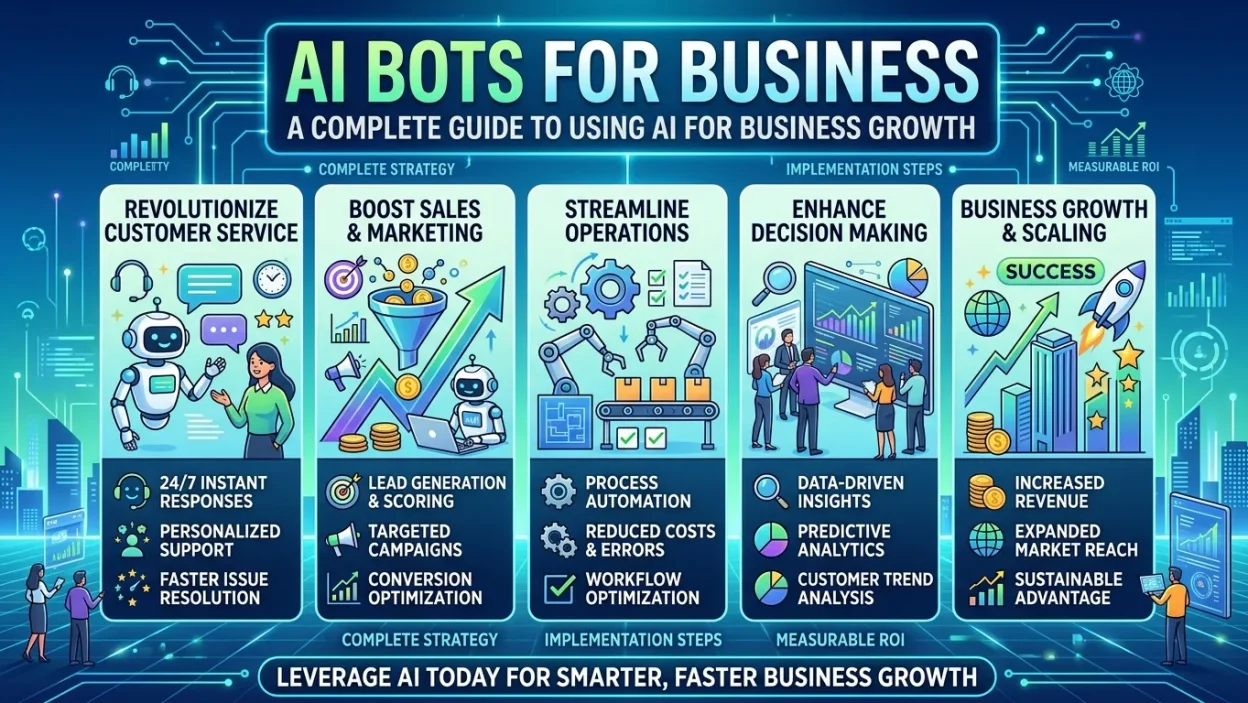
AI bots for business help companies automate communication, customer support, lead generation, sales assistance, and repetitive tasks. From AI chatbots and virtual assistants to automated customer service systems, businesses can use AI to respond faster and provide support around the clock. With the right strategy, AI bots can reduce manual work, improve customer experiences, and help businesses operate more efficiently.
AI bots for business are becoming an increasingly useful technology for companies that want to improve customer communication, automate repetitive tasks, and create more efficient business operations. Artificial intelligence allows businesses to build systems that can understand questions, process information, provide responses, and perform certain tasks with limited human intervention.
Customers today expect fast responses when they contact a company. They may want to know about a product, check an order, ask about pricing, schedule an appointment, or get help with a problem. Businesses that rely entirely on employees to answer every question may struggle to provide immediate support, especially outside normal working hours.
AI bots can help address this challenge by handling many routine interactions automatically. They can work through websites, messaging platforms, applications, and other digital channels, allowing customers to receive assistance without always waiting for a human representative.
What Are AI Bots for Business?
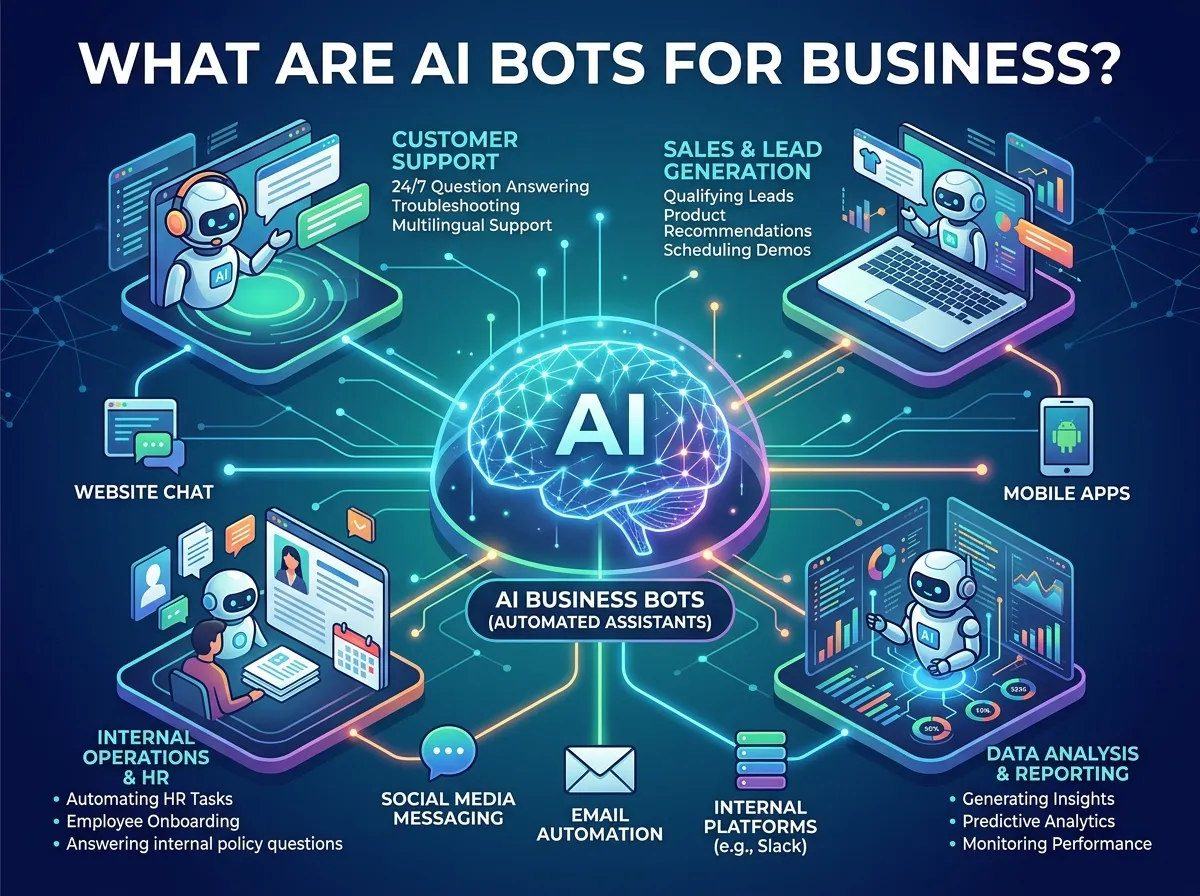
AI bots for business are software systems that use artificial intelligence to communicate with customers, employees, or other users and perform specific tasks. Unlike traditional automated systems that rely entirely on fixed commands, modern AI-powered bots can understand natural language and respond to a wider range of questions.
Businesses can use AI bots for many different purposes. A company may use a bot to answer frequently asked questions, recommend products, collect customer information, qualify leads, schedule appointments, provide technical assistance, or help employees find internal information.
The complexity of a business bot depends on its purpose. A simple bot may answer common questions using predefined information, while a more advanced system can understand conversations, connect with business software, retrieve information, and assist users through multiple steps.
The goal is not necessarily to replace human employees. In many situations, AI bots work best when they handle repetitive interactions while employees focus on complex problems that require judgment, creativity, or personal attention.
AI Chatbots for Businesses
AI chatbots for businesses are among the most common applications of artificial intelligence in customer communication. These chatbots can be placed on websites, applications, messaging platforms, and other digital channels to interact with visitors.
A website chatbot can welcome visitors and ask what they need help with. If someone wants information about a service, the chatbot can provide an explanation. If another visitor wants to contact the sales team, the chatbot can collect relevant information and direct the person to the appropriate next step.
AI chatbots can also provide answers to common questions about pricing, availability, products, services, policies, or business hours. This can reduce the number of repetitive questions employees have to answer manually.
The quality of the chatbot depends heavily on the information it has access to and how well it is designed. Businesses should provide accurate knowledge and create clear processes for situations where the chatbot cannot provide an appropriate answer.
Business AI Automation
Business AI automation involves using artificial intelligence to automate tasks that would otherwise require manual work. Chatbots are one example, but AI automation can support many other business processes.
Businesses can use AI to classify customer inquiries, summarize conversations, organize information, assist with document processing, route requests, and support internal workflows. Automation can help employees spend less time performing repetitive activities and more time on tasks that require human expertise.
For example, a company may receive hundreds of customer inquiries every day. An AI system can identify the subject of each inquiry and route it to the appropriate department. Simple questions can receive automated responses, while more complicated issues can be forwarded to human representatives.
This combination of automation and human support can improve efficiency without removing the human element from important customer interactions.
AI-Powered Business Bots
AI-powered business bots can be designed for different departments and business functions. Marketing teams may use them to answer questions from website visitors and collect leads. Sales teams may use them to qualify prospects and schedule meetings. Customer service teams can use them to provide initial support.
Internal teams can also benefit. An AI bot could help employees locate company policies, find information in internal documents, or answer common questions about business processes.
The advantage of AI-powered bots is their ability to handle conversations and information requests at scale. A human employee may only be able to manage a limited number of conversations at once, while an automated system can handle many interactions simultaneously.
However, businesses need to establish appropriate limits. Bots should not be expected to solve every possible problem. When a request requires complex reasoning, sensitive judgment, or specialized expertise, the system should provide a clear path to human assistance.
AI Customer Service Bots
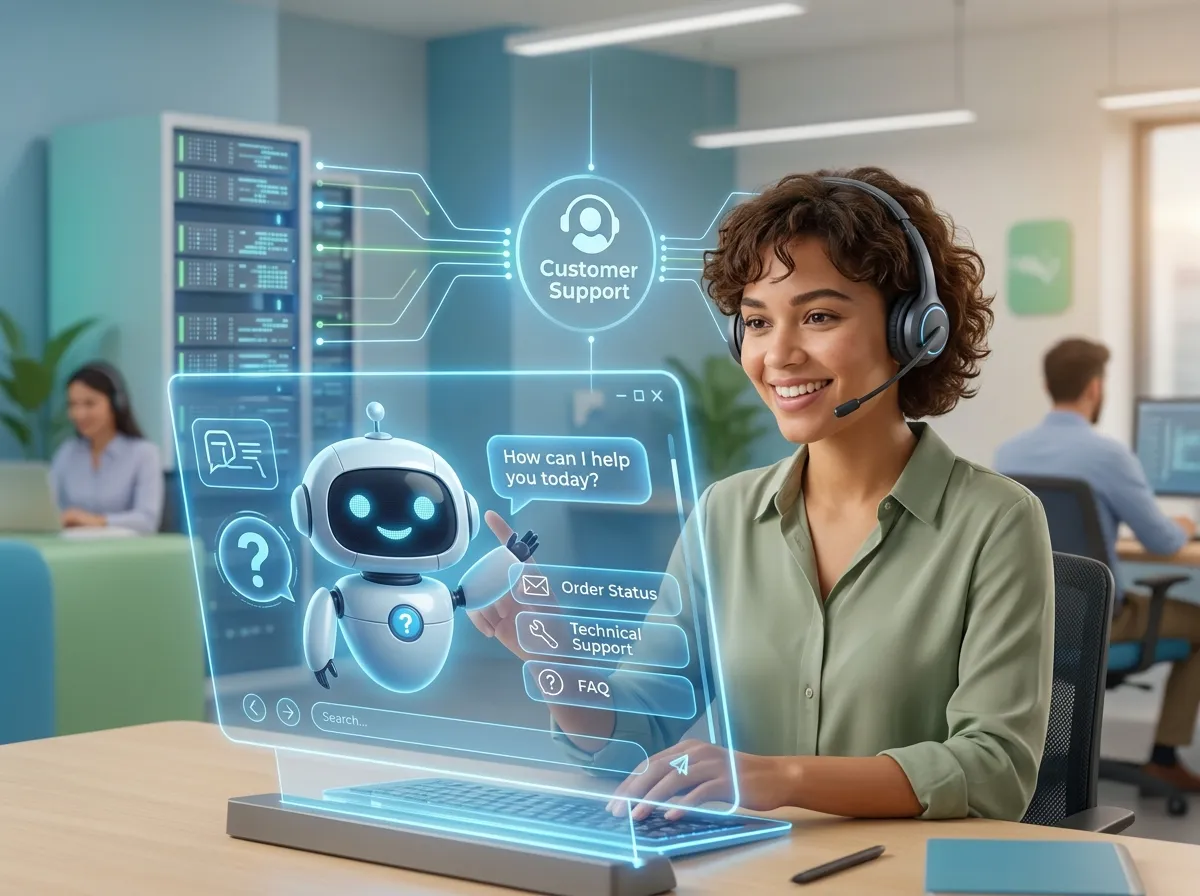
AI customer service bots can help businesses provide faster and more accessible support. Customers often ask repetitive questions, such as how to reset a password, track an order, understand a return policy, or find product information.
An AI bot can answer these questions instantly if it has access to accurate information. This allows customer service employees to focus on more complicated cases.
AI customer service can also be available outside regular business hours. A customer who needs assistance late at night does not necessarily have to wait until the next working day to receive basic information.
However, businesses should carefully monitor automated customer service. Incorrect answers can frustrate customers and damage trust. The system should therefore be tested regularly and updated when business policies, products, or services change.
AI Bots for Customer Support
AI bots for customer support can work as the first point of contact between a customer and a company. Instead of immediately sending every customer to a human agent, the bot can first understand the issue and determine what type of assistance is required.
For straightforward questions, the bot can provide an answer. If the issue requires human intervention, the conversation can be transferred to a customer service representative along with relevant information collected during the interaction.
This can make support more efficient because customers do not always have to repeat the same information when they are transferred to a human agent.
Businesses can also analyze conversations to identify recurring problems. If customers repeatedly ask about the same product feature or encounter the same difficulty, the company can use that information to improve its product, website, documentation, or customer service process.
Business Chatbot Solutions
Business chatbot solutions can range from simple website chat tools to sophisticated AI systems integrated with customer relationship management platforms, help desks, ecommerce systems, scheduling software, and other business applications.
The right solution depends on the company’s goals. A small business may only need a chatbot that answers common questions and collects leads. A larger organization may need an AI system that can connect to multiple databases and support customers across several communication channels.
Before implementing a chatbot, businesses should identify the problems they want to solve. Choosing technology first and looking for a use case afterward can result in unnecessary complexity.
A better approach is to identify repetitive tasks, customer frustrations, response delays, and opportunities for automation. The chatbot can then be designed around those specific needs.
AI Chatbot Automation
AI chatbot automation allows businesses to create automated conversations that guide customers toward specific outcomes. The bot can ask questions, analyze responses, provide information, and trigger actions based on the user’s needs.
For example, a service business could use a chatbot to ask visitors what type of service they require. It could then collect their location, preferred appointment time, and contact information before sending the request to the appropriate team.
An ecommerce business could use chatbot automation to help customers find products. The bot could ask about preferences and provide relevant recommendations based on the available product information.
Automation can make these processes faster, but the conversation should remain simple and understandable. Customers should always know what the bot is doing and how they can reach a human if necessary.
AI Virtual Assistants for Business
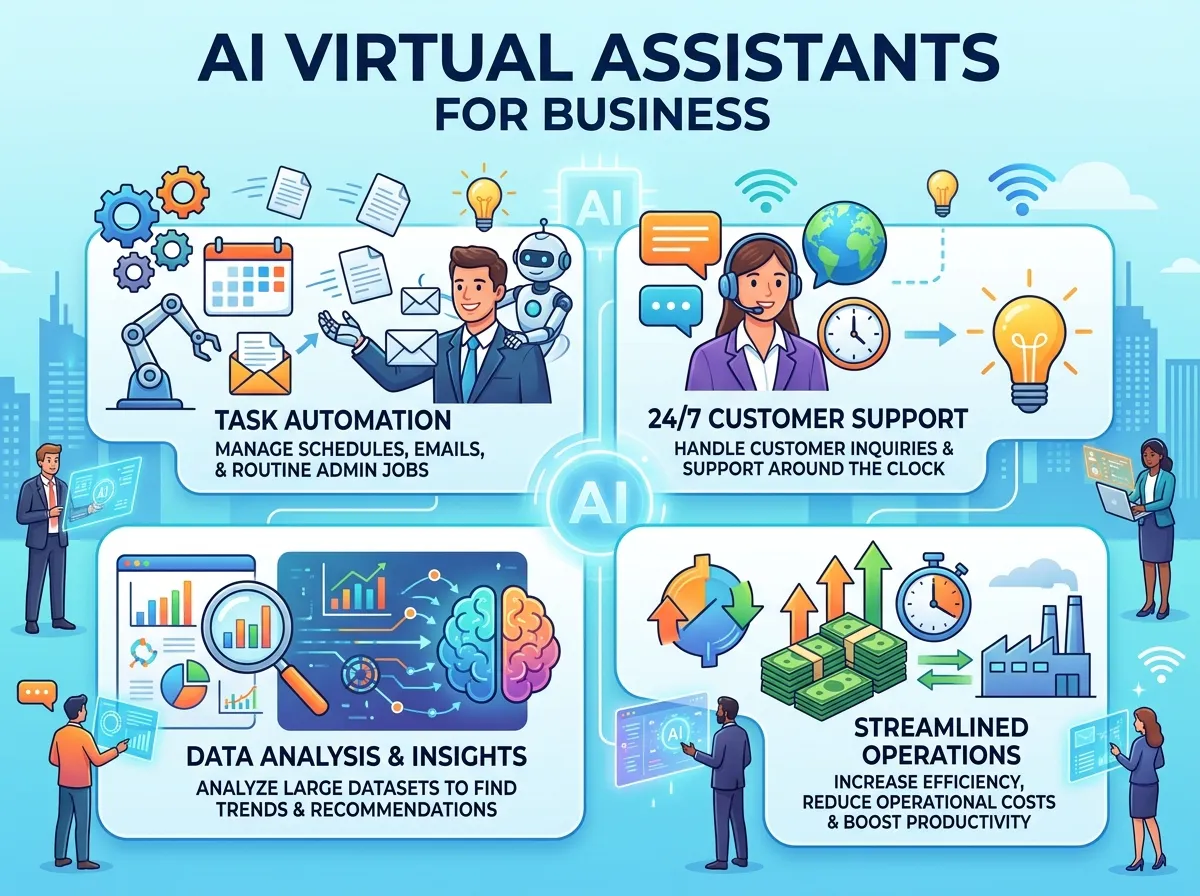
AI virtual assistants for business can perform broader tasks than traditional customer service chatbots. They may help employees organize information, manage schedules, draft communications, retrieve data, summarize documents, or support internal processes.
For example, an employee could ask an AI assistant to summarize a long document or locate information within a company’s internal knowledge base. A sales representative could use an assistant to prepare information before a customer meeting.
Virtual assistants can therefore support both external and internal operations. Their value depends on how well they are connected to the information and tools employees actually use.
Security and access controls are particularly important when AI assistants interact with internal company information. Businesses should ensure that employees only have access to information they are authorized to view.
AI Bots for Lead Generation
AI bots for lead generation can help businesses turn website visitors into potential customers. Instead of asking visitors to search through a website to find contact information, a chatbot can proactively offer assistance.
The bot can ask visitors what they are looking for and collect basic information such as their needs, company type, project requirements, or preferred contact method. This information can then be sent to the sales team.
AI bots can also help qualify leads. For example, the bot may identify whether someone is looking for a product that the company actually provides, whether they need a specific service, or whether they are interested in scheduling a conversation.
This can save sales teams time because they can prioritize prospects who show stronger interest or better fit the company’s target customer profile.
AI Chatbot for Small Businesses
An AI chatbot for small businesses can provide many of the same basic benefits as larger enterprise systems without requiring a large customer service department.
Small businesses often have limited resources, which means employees may need to handle customer support, sales, marketing, and administrative tasks at the same time. A chatbot can take care of repetitive questions and basic inquiries, allowing employees to focus on higher-value work.
For example, a local service provider could use a chatbot to explain services, provide business hours, collect inquiries, and help customers request appointments. An online store could use one to answer product questions and assist customers with basic order information.
Small businesses should begin with a focused use case rather than trying to automate everything. Starting with a small and measurable project makes it easier to evaluate whether the technology is actually providing value.
Benefits of AI Bots for Business
One of the biggest advantages of AI bots for business is speed. Customers can receive responses immediately instead of waiting for an employee to become available.
AI bots can also provide support outside traditional working hours. This can be particularly valuable for businesses that serve customers across different time zones or receive inquiries outside normal office hours.
Another advantage is scalability. As the number of customer inquiries increases, businesses can use automation to handle routine conversations without increasing their support team at the same rate.
AI bots can also improve consistency. A properly configured system can provide the same accurate information to customers across multiple conversations. For businesses focused on customer relationships, AI chatbots for CRM can also help connect automated conversations with customer relationship management activities.
In addition, businesses can use chatbot interactions as a source of customer insights. Analyzing common questions and requests can help companies identify customer needs and improve their products, services, and marketing.
Challenges of Using AI Bots
Despite their advantages, AI bots are not perfect. One of the biggest challenges is accuracy. If an AI system provides incorrect information, customers may lose confidence in the business.
Another challenge is understanding complex or unusual questions. Customers do not always communicate in predictable ways, and a bot may struggle when a conversation goes beyond its available knowledge.
Businesses also need to consider privacy and security. If an AI system processes customer information, organizations should establish appropriate data protection practices and access controls. Ethical considerations are also important, and businesses should follow principles such as transparency, fairness, and responsible AI use. Companies can learn more about ethical AI chatbots when developing responsible chatbot experiences.
The customer experience should also remain a priority. Some people prefer speaking with a human, especially when dealing with complicated or sensitive problems. Businesses should make it easy for customers to reach a human representative when necessary.
How to Implement AI Bots Successfully
Successful implementation begins with a clear business objective. Instead of adopting AI simply because it is popular, businesses should identify a specific problem that automation can solve.
The next step is to determine what information the bot needs. Accurate product details, service information, policies, frequently asked questions, and other relevant knowledge should be organized and maintained.
Businesses should also define when the bot should transfer a conversation to a human. This is particularly important for complex complaints, technical issues, payment problems, or situations that require judgment.
After launch, performance should be monitored. Businesses can review conversation outcomes, customer feedback, unanswered questions, lead quality, and other relevant metrics. These insights can also help businesses improve broader digital communication and visibility efforts, including automotive digital PR for companies operating in the automotive industry.
Continuous improvement is essential because customer questions and business information change ove
The Future of AI Bots for Business
AI bots are likely to become increasingly integrated into business operations as artificial intelligence improves. Future systems may be able to understand customer intent more accurately, interact across multiple channels, use business data more effectively, and perform more complex tasks.
Businesses may increasingly use AI as a layer that connects customers, employees, data, and software systems. Instead of simply answering questions, AI assistants may help complete entire workflows.
However, human involvement will remain important. Businesses need people to make strategic decisions, handle complex situations, build relationships, and provide empathy when customers need it. This is particularly relevant when AI is used in sensitive areas, where specialized solutions such as mental health chatbots may require additional safeguards and careful human oversight. Mental health chatbots illustrate how important responsible design can be when AI interacts with people in sensitive situations.
The most effective future model is likely to involve collaboration between humans and AI rather than complete replacement of human interaction.
Final Thoughts
AI bots for business can help companies improve customer communication, automate repetitive tasks, generate leads, and make everyday operations more efficient. From AI chatbots for businesses and customer service bots to virtual assistants and automated lead generation systems, businesses have many opportunities to use artificial intelligence.
The key is to focus on practical business needs. A successful AI bot should solve a genuine problem, provide accurate information, create a better customer experience, and make work easier for employees.
Businesses should start with a clear use case, provide reliable information, establish human handoff processes, monitor performance, and continuously improve the system. When implemented thoughtfully, AI bots can become a valuable part of a modern digital strategy and support sustainable business growth.
Frequently Asked Questions
1. What are AI bots for business?
AI bots for business are software systems that use artificial intelligence to communicate with customers or employees and perform specific tasks. They can answer questions, provide support, collect leads, automate workflows, and assist with various business processes.
2. How can businesses use AI chatbots?
Businesses can use AI chatbots for customer support, lead generation, product recommendations, appointment scheduling, frequently asked questions, sales assistance, and other repetitive communication tasks.
3. Can AI bots replace customer service employees?
AI bots can automate many repetitive customer service tasks, but they do not necessarily replace human employees. Complex problems, sensitive situations, and conversations requiring empathy or judgment often benefit from human assistance.
4. How do AI bots help with lead generation?
AI bots can engage website visitors, ask questions about their needs, collect contact information, qualify prospects, and send relevant leads to sales teams. This can make the lead-generation process faster and more organized.
5. Are AI chatbots useful for small businesses?
Yes. An AI chatbot for small businesses can answer common questions, collect inquiries, provide information, and support customers outside regular business hours. Small companies can start with simple use cases and expand automation over time.
6. What is AI chatbot automation?
AI chatbot automation involves using an AI-powered system to automatically manage conversations and perform actions based on customer responses. It can include answering questions, collecting information, qualifying leads, and directing users to appropriate resources.
7. What are AI customer service bots?
AI customer service bots are automated systems designed to assist customers with questions and common support requests. They can provide immediate answers and transfer more complicated cases to human representatives.
8. What are AI virtual assistants for business?
AI virtual assistants for business are AI systems that can help employees or customers perform tasks such as retrieving information, summarizing documents, managing schedules, answering questions, and supporting business workflows.
9. What should businesses consider before implementing an AI bot?
Businesses should consider their goals, target users, available information, integration requirements, security, privacy, customer experience, costs, and the situations where human assistance will be necessary.
10. How can businesses measure AI chatbot performance?
Businesses can measure chatbot performance through response rates, resolution rates, customer satisfaction, lead generation, conversion rates, handoff rates, response time, and the number of conversations successfully handled without human intervention.


How to Improve Chatbot User Experience for Better Engagement
How AI Chatbots for eCommerce Help Businesses Increase Conversions
The Future of Generative AI Chatbots in Business Automation
How AI Chatbot Development Automates Business Communication