

Automated customer support is changing the way businesses communicate with customers. Instead of relying entirely on human agents, companies can use automation to answer common questions, provide instant assistance, guide customers through simple processes, and offer support outside regular business hours.
When implemented properly, automation does more than reduce support workload. It can improve response times, create more consistent customer experiences, and help businesses build stronger relationships with their audiences. Technologies such as Chatbot automation, Conversational AI, and AI chatbots make it possible to provide fast and personalized assistance while still allowing human agents to handle complex situations. The goal is not to remove the human element from customer service. Instead, automated support should work alongside support teams to make customer interactions faster, easier, and more convenient.
What Is Automated Customer Support?
Automated customer support uses software, artificial intelligence, chatbots, knowledge bases, and predefined workflows to handle customer service tasks without requiring a human agent for every interaction. Customers can receive immediate answers to frequently asked questions, order updates, account information, troubleshooting instructions, and other basic assistance.
For example, an online store can automatically answer questions about shipping times, return policies, payment methods, and product availability. If a customer has a more complicated problem, the system can transfer the conversation to a human representative. This combination of automation and human support creates a more efficient customer service experience.
Why Automated Customer Support Matters for Customer Relationships

Provides Faster Responses
Customers generally do not want to wait hours for an answer to a simple question. Automation allows businesses to respond immediately to common requests.
Instant responses can reduce frustration and make customers feel that their concerns are being taken seriously. Even when a human agent is eventually required, an automated system can acknowledge the request and provide basic information while the customer waits.
Creates Consistent Support Experiences
Human agents may provide different answers depending on their experience, workload, or interpretation of company policies.
Automated systems can deliver standardized information based on approved resources and workflows. This creates greater consistency across customer interactions. A consistent support experience can increase customer confidence because people know what type of information and assistance they can expect from the business.
Makes Support Available Around the Clock
Customers do not always need assistance during standard business hours. They may shop, browse, or experience problems late at night, during weekends, or on holidays.
Automation can provide basic support 24/7. This gives customers access to useful information whenever they need it, even when a human support team is unavailable.
How Chatbot Automation Improves Customer Communication
Chatbot automation is one of the most common applications of automated customer support. Chatbots can communicate with customers through websites, messaging platforms, and other digital channels.
Answer Frequently Asked Questions
Businesses often receive the same questions repeatedly. Examples include:
- What are your business hours?
- How long does delivery take?
- What is your return policy?
- How can I reset my password?
- Where is my order?
- What payment methods do you accept?
A chatbot can answer these questions instantly instead of requiring a support representative to respond manually each time. This saves employee time while giving customers immediate access to information.
Guide Customers Through Simple Processes
Chatbots can also guide customers through step-by-step processes. For example, a chatbot could help a customer locate a product, track an order, update account information, or find a relevant support article. This guided experience reduces the amount of effort customers need to spend searching for answers.
Route Complex Issues to Human Agents
Automation should not attempt to solve every customer problem. When a conversation becomes complicated, emotional, or highly specific, the chatbot can identify the situation and transfer the customer to an appropriate human representative. This creates a better balance between speed and human empathy.
The Role of Conversational AI in Customer Relationships
Conversational AI allows automated systems to understand and respond to customer messages in a more natural way. Traditional automated systems often depend on predefined keywords or menu options. Conversational AI can provide more flexible interactions by interpreting customer questions and responding based on context.
Makes Interactions More Natural
Customers do not always phrase questions in exactly the same way. For example, one customer may ask, “Where is my package?” while another may say, “Can you check my delivery status?” A conversational system can understand that both questions may have the same intent. This makes automated communication feel more natural and reduces the need for customers to use specific commands.
Understands Customer Intent
Conversational AI can analyze customer messages to identify what they are trying to accomplish. A customer asking about a delayed delivery may need order tracking information rather than a general shipping policy. Recognizing this intent allows the system to provide more relevant assistance. More relevant answers can reduce frustration and improve the overall support experience.
Supports Personalized Communication
Automation can become more useful when it uses customer information appropriately. For example, a system may recognize an existing customer, access relevant order information, and provide a response based on that customer’s situation. Personalized interactions can make customers feel understood rather than treated as anonymous support requests.
How AI Chatbots Build Customer Trust
Provide Accurate Information
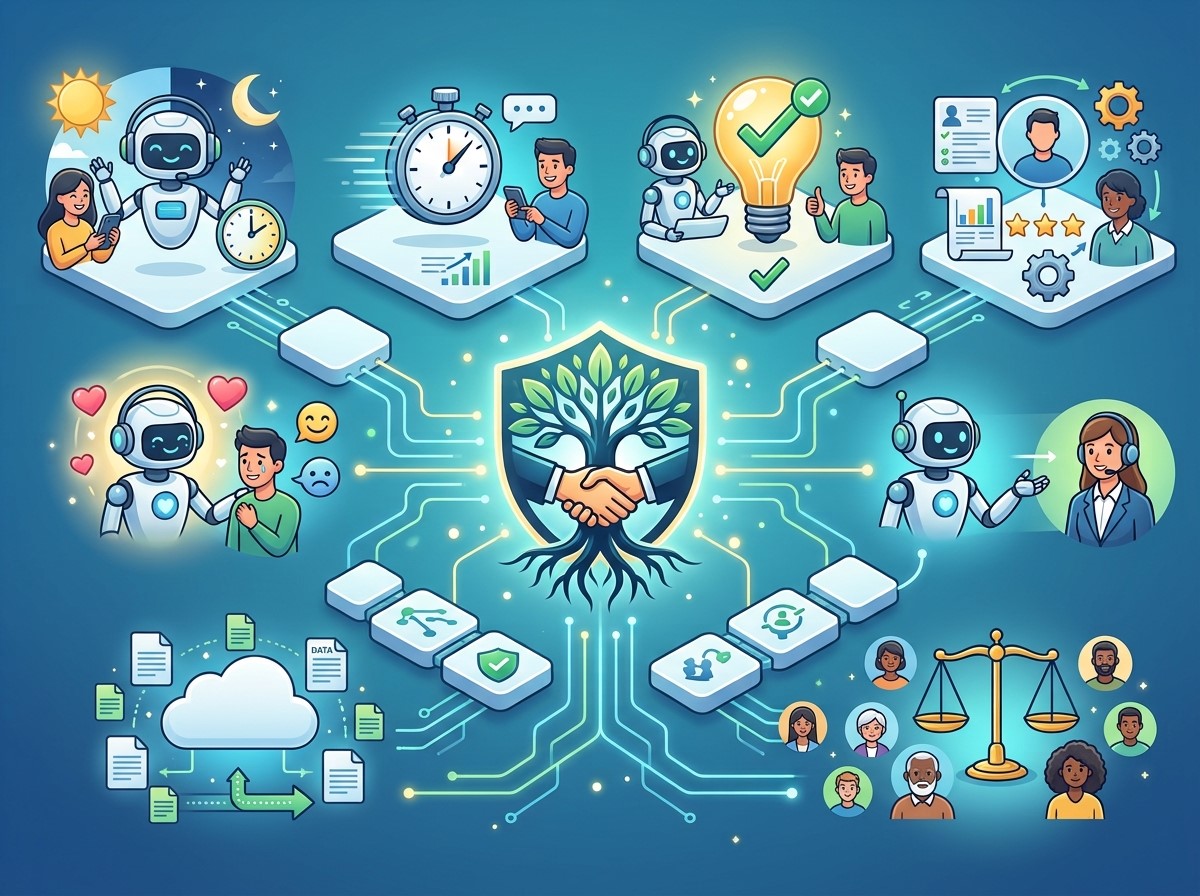
Automated systems should be connected to reliable business information. Outdated or incorrect answers can quickly damage customer confidence. Businesses should regularly review chatbot knowledge bases, product information, policies, and automated responses.
Be Transparent About Automation
Customers should know when they are interacting with an automated system. Being transparent helps set realistic expectations. If the chatbot cannot solve a particular issue, it should clearly explain that a human agent can provide additional help.
Maintain a Clear Human Handoff
Customers should never feel trapped inside an automated system. A visible option to contact a human representative can improve trust and reduce frustration, particularly when the issue is sensitive or complicated.
Using Automated Customer Support Without Losing the Human Touch
One of the biggest concerns about automation is that customer service can become impersonal. However, automation does not have to eliminate human interaction. Instead, it can help employees focus on conversations where their expertise and empathy are most valuable.
Automate Repetitive Tasks
Businesses should automate simple and repetitive requests first. Tasks such as FAQs, appointment reminders, order tracking, password assistance, and basic account questions are often suitable for automation. This allows human agents to spend more time solving complex problems.
Give Customers Control
Customers should have choices during automated interactions. Allowing users to request a human representative, restart a conversation, or choose from different support options gives them greater control over the experience.
Use Human Support for Emotional Situations
Complaints, disputes, sensitive account issues, and emotionally difficult situations often require human understanding. Automation can identify these situations and quickly connect customers with trained representatives.
How Automation Improves Customer Experience
Customer experience is influenced by every interaction a person has with a business. Automated support can improve this experience by reducing unnecessary friction.
Reduce Waiting Time
Immediate assistance can make the customer journey more convenient. Instead of waiting in a support queue for a simple answer, customers can receive information within seconds.
Simplify Problem Solving
Customers may become frustrated when they need to visit multiple pages or contact different departments to solve one problem. A well-designed automated system can guide them toward the correct solution through a simple conversational process.
Support Customers Across Multiple Channels
Modern customers may interact with businesses through websites, mobile applications, social platforms, and messaging services. Automated support can help maintain consistent communication across these channels. When customers receive similar information regardless of where they contact a business, the overall experience becomes more reliable.
Using Customer Data to Improve Automated Support
Automation becomes more effective when businesses learn from customer interactions. Support teams can analyze frequently asked questions, common complaints, conversation outcomes, and customer feedback to identify areas for improvement.
For example, if customers repeatedly ask how to return a product, the company may need to make its return policy easier to find. Similarly, repeated questions about a product feature may indicate that product descriptions need improvement. This means automated support can provide insights that improve not only customer service but also the wider customer journey.
Measuring the Success of Automated Customer Support

Monitor Customer Satisfaction
Customer satisfaction surveys can reveal whether customers find automated support useful. If satisfaction scores decrease, businesses should examine where customers are experiencing difficulties.
Track Resolution Rates
A high resolution rate can indicate that automation is successfully handling common requests. However, businesses should also examine whether customers are genuinely receiving useful solutions rather than simply ending conversations.
Analyze Escalations
Escalation data can show which issues require human support. If a particular type of question is frequently transferred to agents, the automated system may need better information, improved workflows, or a clearer handoff process.
Common Mistakes to Avoid With Automated Customer Support
Automation can create problems when it is implemented without considering customer needs. One common mistake is automating too much too quickly. Not every customer interaction should be handled by a machine.
Another mistake is providing generic responses that do not address the customer’s actual question. Businesses should continuously review automated conversations and improve their systems based on real customer behavior.
Poor human handoffs can also create frustration. Customers should be able to reach a human representative without repeating their entire problem. Finally, businesses should avoid treating automation as a replacement for customer service teams. The strongest approach combines technology with human expertise.
Best Practices for Building Better Customer Relationships
Businesses can make automated support more relationship-focused by following a few principles. First, focus on customer convenience rather than simply reducing operational costs. The system should make it easier for customers to get help.
Second, keep automated responses clear and conversational. Avoid unnecessary technical language. Third, provide easy access to human representatives when automation cannot solve a problem. Fourth, regularly update automated information to prevent inaccurate responses. Finally, use customer feedback to improve the system continuously. When customers see that a business listens and adapts, automation can become part of a positive long-term relationship rather than a barrier to communication.
The Future of Automated Customer Support
The future of customer support will likely involve a combination of automation, artificial intelligence, and human expertise. As AI technology becomes more capable, automated systems will be able to understand customer intent, remember relevant context, personalize conversations, and assist with increasingly complex tasks.
However, human support will remain important for situations requiring empathy, judgment, negotiation, and deeper problem-solving. The most successful businesses will not simply automate customer service. They will design support systems where technology and people work together to create faster, more helpful, and more trustworthy customer experiences.
Conclusion
Automated customer support can play an important role in building stronger customer relationships. By providing faster responses, consistent information, 24/7 availability, and personalized assistance, automation can make customer interactions more convenient and efficient.
Technologies such as Chatbot automation, Conversational AI, and AI chatbots give businesses powerful tools for handling repetitive requests while allowing human agents to focus on more complex customer needs.
Frequently Asked Questions
1. What is automated customer support?
Automated customer support uses software, chatbots, artificial intelligence, and automated workflows to handle common customer service requests without requiring a human agent for every interaction.
2. How does automated customer support improve customer relationships?
It improves relationships by providing faster responses, consistent information, convenient access to support, and assistance outside normal business hours.
3. Can automated customer support replace human agents?
No. Automation is best used to handle repetitive tasks while human agents manage complex, sensitive, or emotional customer interactions.
4. What is chatbot automation?
Chatbot automation uses automated conversational systems to answer questions, provide information, guide customers, and complete basic support tasks.
5. How does Conversational AI improve customer service?
Conversational AI can understand customer intent and context, allowing automated systems to provide more natural and relevant responses.
6. Are AI chatbots useful for small businesses?
Yes. AI chatbots can help small businesses provide faster responses, answer common questions, and reduce the workload placed on limited support teams.
7. Can automated support provide personalized customer service?
Yes. When connected with relevant customer and business data, automated systems can provide responses based on a customer’s account, order, preferences, or previous interactions.
8. How can businesses maintain the human touch with automation?
Businesses can maintain the human touch by offering easy human handoffs, using automation mainly for repetitive tasks, and assigning complex or sensitive situations to trained support representatives.
9. What metrics should businesses track for automated support?
Businesses can track customer satisfaction, response time, resolution rate, escalation rate, conversation completion rate, and overall support volume.
10. What is the future of automated customer support?
The future will likely combine AI-powered automation with human expertise. Automated systems will handle more routine and contextual tasks while human agents focus on situations requiring empathy, judgment, and complex problem-solving.



Live Chat Automation Best Practices to Improve Customer Service
How Virtual Assistants Help Small Businesses Grow Faster
How Automated Customer Support Builds Better Customer Relationships
Chatbot Automation for Business Growth: Improve Support, Sales, and ROI