

Intelligent chatbots are changing how businesses communicate with customers by making digital interactions faster, more responsive, and more personalized. Unlike basic rule-based systems that rely on limited conversation paths, intelligent chatbots can understand different types of customer questions, recognize context, and provide relevant information based on the interaction.
Customer expectations have also changed. People increasingly want quick answers, convenient support, and consistent communication across digital channels. Businesses that rely entirely on manual support may struggle to respond efficiently when customer inquiries increase. Intelligent chatbots can help manage routine conversations while allowing human teams to focus on more complex customer needs.
What Are Intelligent Chatbots?
Intelligent chatbots are advanced conversational systems designed to understand user requests and respond in a more flexible and context-aware way. They can use artificial intelligence, natural language processing, customer data, and business information to support different types of interactions.
Understanding Customer Intent
A major advantage of intelligent chatbots is their ability to interpret customer intent. Customers do not always use exact keywords or predefined phrases when asking questions.
An intelligent chatbot can analyze the wording and context of a message to determine what the customer may need. This allows conversations to feel more natural than traditional menu-based systems.
Learning From Conversations
Depending on the system and implementation, intelligent chatbots can use conversation data and feedback to improve their performance. Businesses can review unsuccessful interactions and update chatbot workflows, knowledge sources, or responses. Continuous improvement is important because customer questions and business information can change over time.
How Intelligent Chatbots Improve Customer Engagement

Providing Faster Interactions
Long response times can cause customers to abandon conversations or look for information elsewhere. Intelligent chatbots can respond immediately to many routine questions.
Fast communication allows customers to continue their journey without waiting for a human representative. This can be particularly useful when customers need basic information about products, services, availability, or business processes.
Supporting Continuous Communication
Customers may interact with businesses outside traditional working hours. Intelligent chatbots can remain available around the clock for supported requests.
Continuous availability allows businesses to provide basic assistance even when human agents are unavailable. When a question requires human expertise, the chatbot can collect relevant information and prepare the conversation for escalation.
The Role of Conversational AI
Conversational AI enables systems to communicate with users using natural language. It can combine technologies such as natural language processing, machine learning, and language understanding to create more flexible digital conversations.
Creating Natural Conversations
Traditional automated systems may require users to follow strict menus. Conversational AI can make interactions more flexible by allowing customers to communicate using everyday language.
This can reduce the effort required to find information. Customers can explain what they need in their own words instead of trying to identify the exact command or option expected by the system.
Maintaining Conversation Context
Context can help a chatbot understand what a customer means based on earlier messages. For example, if a customer asks about a product and then asks about its delivery time, the system may use the previous conversation to understand which product they mean. Maintaining context can make conversations feel more connected and reduce repetitive questions.
How Automated Customer Support Improves Engagement
Automated customer support can help businesses manage routine customer interactions efficiently. Intelligent chatbots can provide first-level assistance while human agents focus on issues that require specialized attention.
Answering Frequently Asked Questions
Businesses often receive repeated questions about pricing, business hours, product features, shipping, returns, account processes, and basic troubleshooting.
Chatbots can provide answers to these common questions immediately. This reduces the need for customers to wait for a support representative and allows employees to focus on more complex requests.
Routing Complex Requests
Not every customer problem should be handled by automation. Intelligent chatbots can identify when an issue requires human assistance and route the conversation to the appropriate team.
A clear escalation process can prevent frustration by ensuring that customers are not trapped in an automated conversation that cannot solve their problem.
Using Automated Responses Effectively
Automated responses can help businesses communicate quickly and consistently across customer touchpoints. However, automation should be designed carefully so that messages remain useful rather than repetitive or impersonal.
Personalizing Automated Messages
Automated responses can be personalized using relevant information such as customer names, previous interactions, selected products, or the current stage of a customer journey.
Personalization should be based on appropriate data and responsible practices. The goal is to make communication more relevant without creating an uncomfortable or intrusive experience.
Delivering Contextual Information
A useful automated response should address the customer’s immediate need. Instead of sending generic information, businesses can create different responses for different customer intents.
For example, a customer asking about delivery can receive shipping information, while someone asking about product features can receive relevant specifications or educational resources.
Intelligent Chatbots Across the Customer Journey
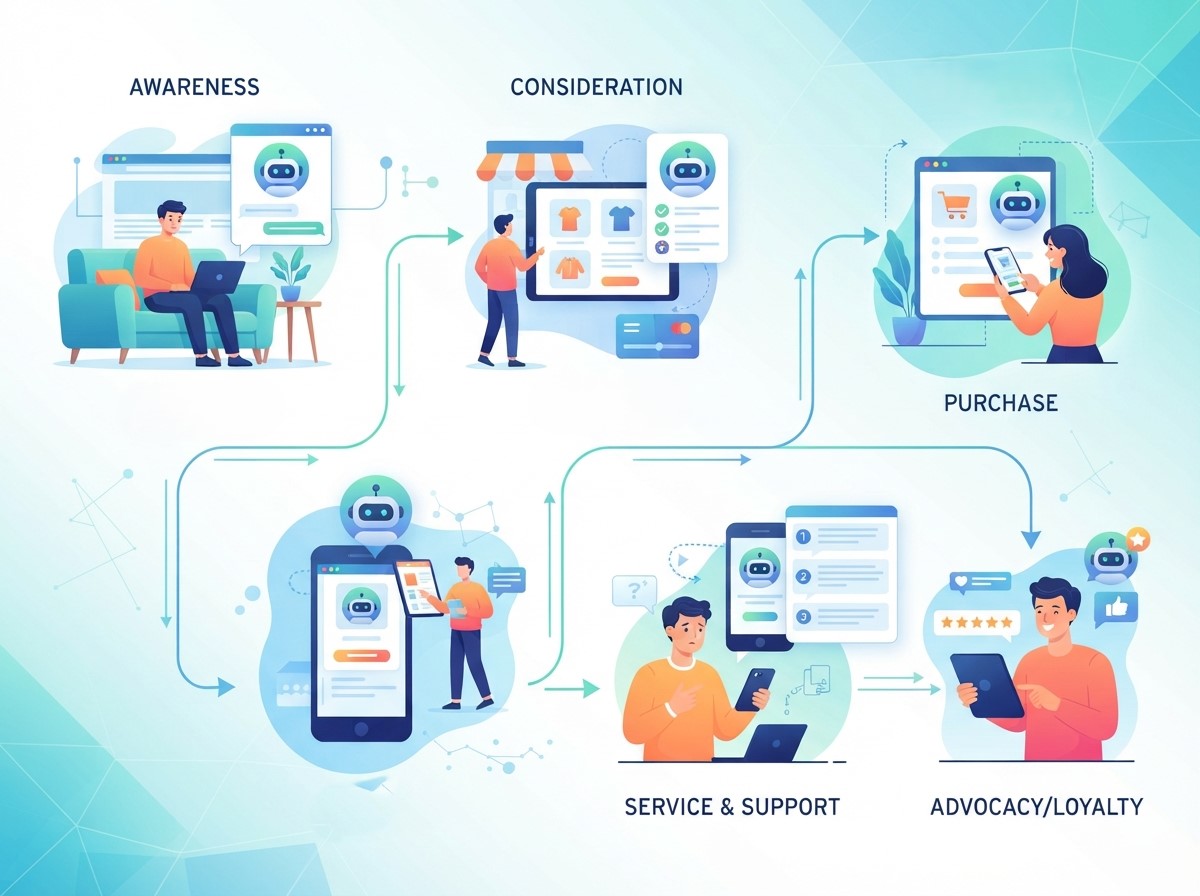
Supporting Potential Customers
During the awareness and consideration stages, chatbots can answer product questions, explain services, recommend relevant resources, and collect basic lead information.
A chatbot can also guide visitors toward appropriate pages or resources. This can reduce navigation difficulties and help potential customers find information more efficiently.
Supporting Existing Customers
After purchase, customers may need assistance with order information, account questions, product usage, returns, or troubleshooting.
Intelligent chatbots can provide basic support and direct customers toward appropriate resources. If the issue is complex, the chatbot can transfer the conversation to a human representative with relevant context.
Personalization and Customer Engagement
Personalized interactions can make customer communication more relevant. Intelligent chatbots can use approved customer information to tailor responses based on individual needs and interaction history.
Understanding Customer Preferences
Businesses may collect information about customer interests, previous purchases, frequently requested topics, or preferred services. When used appropriately, this information can help chatbots provide more relevant assistance.
For example, returning customers may receive information related to previous interactions instead of starting from generic introductory content.
Recommending Relevant Products or Content
Intelligent chatbots can guide customers toward products, services, articles, tutorials, or support resources based on their stated needs.
Relevant recommendations can reduce the time customers spend searching for information. This can improve convenience and encourage customers to explore additional offerings when appropriate.
Integrating Intelligent Chatbots With Business Systems
Chatbots become more useful when they are connected with relevant business tools and information systems. Integration can allow chatbots to access appropriate data and trigger specific workflows.
Connecting Customer Relationship Systems
Integration with customer relationship management platforms can help businesses organize customer information and interaction history.
When relevant information is available, customer service representatives may have more context when taking over a conversation. This can create a smoother transition between chatbot and human support.
Connecting Support and E-Commerce Systems
Businesses can connect chatbots with support platforms, product databases, inventory systems, and order management tools where appropriate.
These integrations can allow chatbots to provide more useful information instead of relying only on static responses. Security and access controls should always be considered when connecting customer-facing systems.
Building Trust With Intelligent Chatbots
Engagement is not only about speed. Customers also need accurate information, transparency, and easy access to human assistance when necessary.
Providing Accurate Information
Incorrect chatbot responses can damage customer trust. Businesses should regularly review chatbot knowledge sources and update information when products, services, pricing, policies, or processes change.
Testing chatbot responses can help identify outdated or misleading information before it affects a large number of customers.
Being Transparent About Automation
Businesses may choose to tell customers when they are interacting with an automated system. Clear communication can help set appropriate expectations about what the chatbot can and cannot do.
Customers should also have a practical way to reach human support when automation cannot adequately address their needs.
Measuring Intelligent Chatbot Performance

Tracking Engagement Metrics
Businesses can monitor conversation volume, engagement rates, completion rates, customer satisfaction, repeat interactions, and escalation rates.
These metrics can reveal whether customers are finding chatbot interactions useful. High conversation volume alone does not necessarily indicate success if customers frequently abandon conversations or request human assistance.
Analyzing Customer Feedback
Direct customer feedback provides additional insight into chatbot performance. Businesses can ask customers whether their questions were answered and provide options for reporting unsuccessful interactions.
Reviewing conversations and feedback regularly can help improve chatbot workflows, response quality, and customer experience.
Best Practices for Using Intelligent Chatbots
Businesses should approach chatbot implementation with clear objectives and customer needs in mind. Automation works best when it solves practical problems rather than being introduced simply because the technology is available.
Start With High-Value Use Cases
Businesses can begin by identifying repetitive questions and processes that consume significant support resources. Common examples include frequently asked questions, appointment information, product guidance, order updates, and basic troubleshooting.
Starting with focused use cases makes it easier to measure results and identify improvements.
Keep Human Support Available
Intelligent chatbots should complement human support rather than create barriers to it. Customers should have a clear path to human assistance when their problem is complex or sensitive.
A well-designed handoff can include the conversation history and relevant customer information so the customer does not need to repeat everything.
Continuously Improve the Experience
Chatbot performance should be reviewed regularly. Businesses can analyze failed conversations, customer feedback, frequently asked questions, and escalation patterns to identify improvement opportunities.
Regular updates can help ensure that chatbot responses remain accurate, useful, and aligned with changing customer expectations.
Conclusion
Intelligent chatbots can help businesses create faster, more relevant, and more convenient customer interactions. By understanding customer intent, maintaining conversational context, answering routine questions, and guiding customers through different processes, they can support stronger engagement across digital channels.
Conversational AI makes chatbot interactions more flexible, while Automated customer support can reduce repetitive workloads and provide continuous assistance. Carefully designed Automated responses can also deliver timely and relevant information throughout the customer journey.
Frequently Asked Questions
1. What are intelligent chatbots?
Intelligent chatbots are advanced conversational systems that use technologies such as artificial intelligence and natural language processing to understand customer requests and provide relevant responses.
2. How do intelligent chatbots improve customer engagement?
They can provide faster responses, support customers continuously, understand natural language, offer relevant information, and guide users through different stages of the customer journey.
3. What is Conversational AI?
Conversational AI refers to technologies that allow software systems to communicate with people using natural language. It can support more flexible and context-aware conversations.
4. What is Automated customer support?
Automated customer support uses technology to handle routine customer service tasks without requiring a human representative for every interaction. Chatbots are one common example of this approach.
5. How do Automated responses help businesses?
Automated responses allow businesses to provide timely and consistent information for common customer requests. They can support questions, notifications, confirmations, and other repetitive communication tasks.
6. Can intelligent chatbots replace human customer service?
They can handle many routine interactions, but human support remains important for complex, sensitive, or unusual situations. The most effective approach often combines automation with human assistance.
7. Can intelligent chatbots personalize customer interactions?
Yes. When appropriate customer information is available, chatbots can use relevant context to provide more personalized responses, recommendations, and support.
8. How can businesses measure chatbot engagement?
Businesses can track conversation volume, completion rates, customer satisfaction, escalation rates, repeat interactions, response quality, and customer feedback to evaluate chatbot performance.
9. Are intelligent chatbots available 24/7?
Yes. Chatbots can operate continuously and respond to supported requests outside normal business hours. Complex cases can be transferred to human representatives when necessary.
10. What are the best practices for implementing intelligent chatbots?
Businesses should start with useful and repetitive use cases, maintain accurate information, provide clear human handoffs, protect customer data, personalize interactions appropriately, and continuously review performance.



How Intelligent Chatbots Drive Better Customer Engagement
How Chatbot Technology Helps Automate Customer Interactions
How Automated Responses Improve Customer Support Efficiency
Live Chat Automation Best Practices to Improve Customer Service